
From Cutting to Canopy: Optimizing Transplant Readiness in No-Veg Cannabis
A whitepaper by Innexo BV – Research by Timo Hoofwijk

Efficient propagation is a cornerstone of high-performance no-vegetative (no-veg) cannabis cultivation. In no-veg systems, cuttings are transplanted directly into flowering conditions, leaving little room for recovery from poor root development. To support more predictable and efficient production, Timo Hoofwijk conducted a controlled cultivation study at Innexo to quantify how root development at transplant influences plant growth, yield, and quality.
Why Root Development Matters
In commercial practice, transplant timing is often based on experience rather than measurable thresholds. This study introduces a standardized visual root scoring system (0–5) to assess transplant readiness and links these scores to downstream crop performance in a real-world production environment.

The Trial
Three high-THC cannabis cultivars (PC64, Skunk, and Strawberry) were propagated, visually scored for root development, and transplanted directly into flowering conditions (12/12 photoperiod). Plants were grown to harvest under standardized greenhouse conditions, with detailed measurements of plant architecture, biomass allocation, yield, and flower chemistry.
Key Findings
Optimal rooting maximizes efficiency
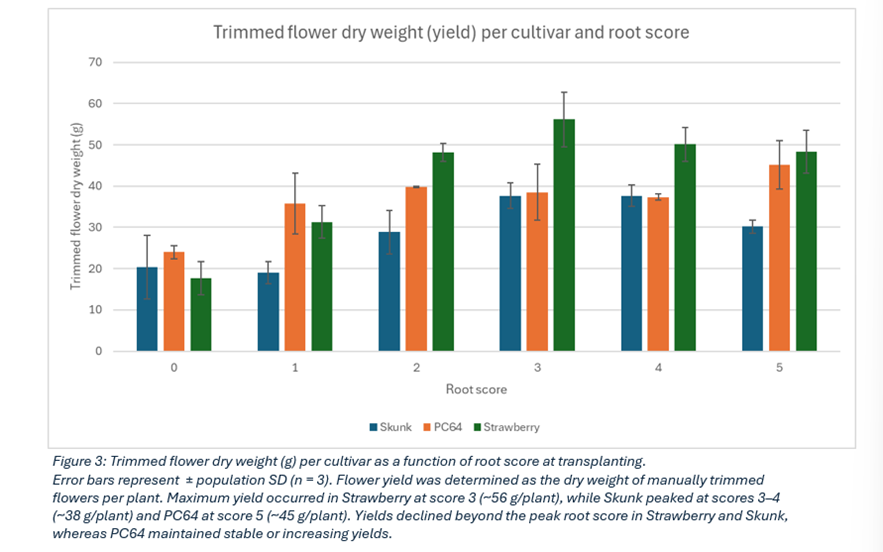
Cuttings transplanted at root scores 2–3 (“optimally rooted”) delivered the highest flower yield and harvest index (≈0.53) in Skunk and Strawberry. These plants balanced vegetative growth and flower production most efficiently.
Under- and over-rooting reduce performance
Under-rooted cuttings (scores 0–1) showed slower establishment, reduced height, lower yield, and reduced harvest efficiency.
Over-rooted cuttings (scores 4–5) produced larger plants, but allocated more biomass to stems and leaves, reducing flower efficiency.
Cultivar-specific responses
While Skunk and Strawberry showed clear performance declines when over-rooted, PC64 tolerated higher root scores, maintaining stable yield and efficiency up to score 5. This highlights the importance of cultivar-specific propagation strategies.
Flower quality remains unchanged
Cannabinoid and terpene profiles were not affected by root score. Root development influenced how much biomass was produced and where it was allocated, not the chemical composition of the flowers.

Practical Implications for Growers
This study provides evidence-based rooting thresholds for no-veg cannabis systems:
Skunk & Strawberry: transplant at root score 2–3
PC64: transplant window 2–5
Applying root-score screening during propagation helps growers:
Improve crop uniformity
Avoid unnecessary propagation time
Maximize flower yield and harvest efficiency
Increase predictability in no-veg production cycles
Moving Toward Data-Driven Propagation
By linking early root development to final crop performance, this research strengthens the scientific foundation of no-veg cannabis cultivation. It demonstrates that propagation decisions directly shape yield efficiency, even when flower quality remains constant.
More Information
This whitepaper is based on the Bachelor internship research of Timo Hoofwijk, conducted at Innexo BV. To receive the full report contact: dewi.delange@innexo.nl


